MDMA Crystal Colors Explained: Purple, Green, and Blue — What’s the Difference?
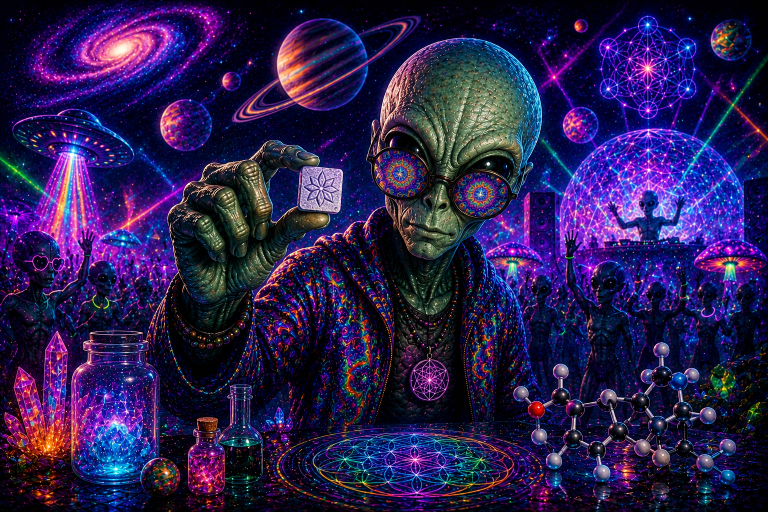
Ever found yourself staring at a small baggie of crystals, wondering about the story behind their colour? One day it’s a collection of champagne-coloured shards, the next it’s a vibrant purple that looks almost otherworldly. In the unregulated marketplace of psychedelics, MDMA comes in a veritable rainbow of hues: purple, green, blue, brown, and even black. This kaleidoscope of colours has given rise to a pervasive set of myths. Is purple MDMA a sign of a “premium” batch? Does a brownish tint mean it’s less pure? Or is it all just clever marketing?
The truth is, the colour of MDMA is a matter of chemistry, not an indicator of quality, potency, or a superior experience. In its purest, most unadulterated form, MDMA hydrochloride is a simple white or off-white crystalline substance. Any colour you see is a direct result of impurities left behind during the synthesis process or, in some cases, dyes intentionally added by producers. At AstroBuzz, we are committed to cutting through the noise and providing you with factual, science-backed information. We believe that education is the cornerstone of safety, which is why every single one of our 83+ products, from [LINK: /product-category/mdma/] to [LINK: /product-category/cannabis/], undergoes rigorous lab testing for purity and potency. This post will explore the science behind MDMA crystal colours, debunk the myths, and explain why lab testing is the only reliable way to know what you’re getting.
Key Takeaways
- Pure MDMA is Colourless: In its chemically pure form, MDMA hydrochloride is a white or off-white crystalline solid. Any colour—be it purple, green, blue, or brown—is a direct indication of chemical impurities or added dyes.
- Colour Is a Fingerprint of Synthesis, Not Quality: The specific hue of an MDMA crystal is determined by the chemical synthesis route used to create it and the success of the purification process. Different methods leave behind different residual chemicals, resulting in a spectrum of colours.
- Myths vs. Reality: The widespread belief that certain colours like purple or blue signify a more potent or “cleaner” product is a dangerous myth. There is no scientific evidence to support this; in fact, a vibrant colour often points to a less pure product.
- The Limits of an Acetone Wash: While washing MDMA with anhydrous acetone can remove some oil-based impurities, it is not a comprehensive purification method. It cannot remove many water-soluble impurities, adulterants, or other dangerous substances.
- Lab Testing Is the Only Guarantee: The only way to be certain of the purity, potency, and safety of an MDMA product is through professional laboratory analysis, such as High-Performance Liquid Chromatography (HPLC). This is the standard for all products sold by AstroBuzz. [LINK: /lab-testing/]
The Allure of Colour: Deconstructing the Myths
In a market devoid of regulation, branding becomes a tool of differentiation. Clandestine producers have long used colour, shape, and stamps to create a signature look for their products. Names like “Purple Amethyst,” “Blue Dolphin,” or “Green Apple” are not scientific classifications but rather marketing terms designed to create a perception of quality and uniqueness. This has led to a deeply entrenched subculture of colour-based folklore, where users associate specific hues with specific experiences.
This is a dangerous game of telephone. A batch of purple MDMA that was particularly good one time is not indicative of all purple MDMA. The next batch could be from a different producer, using a different synthesis method, with a completely different purity profile. The colour is an arbitrary characteristic, not a reliable marker of quality. In many cases, the colour is not even a by-product of the synthesis but a deliberate addition of food colouring to make the product more memorable. This is why a harm reduction approach that prioritizes facts over anecdotes is so critical.
A Deep Dive into the Chemistry of MDMA Colours
To truly understand why MDMA comes in so many colours, we need to look at the chemical processes involved in its creation. Illicit labs are a far cry from the sterile, controlled environments of pharmaceutical manufacturing. The equipment is often makeshift, the chemists may be self-taught, and the focus is on yield, not purity. This leads to a wide range of inconsistencies in the final product.
Synthesis Routes and Their Chemical Fingerprints
The majority of illicit MDMA is synthesized from a few key precursors, most notably safrole, piperonal, and PMK (piperonyl methyl ketone). Each of these starting materials can be converted to MDMA through several different chemical pathways, and each pathway has its own unique set of potential by-products and impurities.
- From Safrole (The “Classic” Route): Safrole, traditionally extracted from the sassafras tree, is a common starting point. One popular method involves converting safrole to MDP2P (3,4-methylenedioxyphenyl-2-propanone), which is then reacted with methylamine. Incomplete reactions or poor purification can leave behind unreacted safrole or other intermediates, which can oxidize and turn the final product a yellowish or brownish colour.
- The Use of Mercury-Aluminum Amalgam: Some older synthesis methods use a mercury-aluminum amalgam for reductive amination. This process is notoriously messy and can leave behind metallic residues that can tint the crystals grey or black.
- The “Leuckart” Route: This method often results in a host of impurities that are difficult to remove and can give the final product a distinct pink or purple hue.
A Colour-by-Colour Chemical Profile
While lab testing is the only way to be certain, forensic chemistry has provided some insights into the likely causes of different colours:
- Brown/Yellow/Tan: This is the most common colour range and is almost always a sign of oxidation. This can happen at various stages of the synthesis or even during storage if the product is exposed to air and light.
- Purple/Pink/Red: These hues are often linked to synthesis routes that use phosphorus-based reagents. The presence of these colours can indicate that the product was not properly “washed” to remove these residual chemicals.
- Green/Blue: These are less common and can be a sign of contamination from copper vessels or other equipment used during synthesis. In some cases, it could also be a result of cross-contamination if the product was stored with other coloured substances.
- Black/Grey: A dark, murky colour is a major red flag. It often indicates a very high level of impurities, significant decomposition of the product, or the presence of dangerous by-products.
The Acetone Wash: A Flawed Purification Method
The practice of “washing” MDMA with acetone is a well-known harm reduction technique in online communities. The theory is that pure MDMA hydrochloride is not soluble in anhydrous (water-free) acetone, while many of the oily, coloured impurities are. By dissolving the impure product in acetone and then filtering it, one can theoretically remove these impurities and be left with a whiter, cleaner product.
However, this method is far from foolproof. Firstly, it requires completely anhydrous acetone. If there is any water in the acetone, it will dissolve the MDMA, leading to a loss of product. Secondly, and more importantly, an acetone wash can only remove a limited range of impurities. It will not remove many other dangerous adulterants, such as PMA/PMMA, synthetic cathinones, or other amphetamines, which are often crystalline solids themselves. An acetone wash might improve the aesthetics of your crystals, but it provides a false sense of security. It is a step in the right direction, but it is no substitute for the comprehensive analysis provided by a lab test.
The Unseen Dangers: Adulterants and Potency Variations
The focus on colour distracts from the two most significant dangers of the unregulated MDMA market: adulterants and wildly fluctuating potency. A 2018 study found that only 61% of the “Molly” tested in New York City actually contained any MDMA. The rest was a cocktail of other substances, including synthetic cathinones (often sold as “bath salts”), methamphetamine, and even novel psychoactive substances that have never been tested in humans. Many of these adulterants are also white crystalline powders, making them visually indistinguishable from pure MDMA.
Even if a product is unadulterated, the potency can vary dramatically. One batch of crystals might be 30% MDMA by weight, while another could be over 80%. Without lab testing, there is no way to know. This is why starting with a low dose is such a critical harm reduction practice. For those looking for a safer, more reliable experience, AstroBuzz offers a wide range of lab-tested alternatives, from [LINK: /product-category/ketamine/] to [LINK: /product-category/lsd/].
The AstroBuzz Standard: Your Safety Is Our Priority
At AstroBuzz, we are on a mission to bring transparency and safety to the world of psychedelics. We believe that you have a right to know exactly what you are consuming. That is why we have implemented a rigorous, multi-step quality control process for every product we sell. Every batch is sent to an independent, third-party laboratory for High-Performance Liquid Chromatography (HPLC) testing. This sophisticated analytical technique provides a detailed breakdown of the product’s composition, allowing us to verify its purity and potency with scientific certainty.
When you choose AstroBuzz, you are choosing a company that puts your well-being first. You are choosing to bypass the myths and misinformation of the black market and instead rely on the certainty of science. No more guessing games, no more colour-based folklore—just pure, accurately dosed products you can trust.
Frequently Asked Questions (FAQ)
What is the ideal colour for MDMA?
In its purest form, MDMA hydrochloride is a white or off-white crystalline solid. Therefore, the ideal “colour” is no colour at all. A lack of colour indicates a high level of purity and a successful purification process.
Is it true that brown MDMA is made from safrole?
While a brownish tint is often associated with synthesis from safrole due to oxidation, it is not a definitive indicator. Other synthesis routes can also produce a brown product, and a safrole-based synthesis can produce a white product if purified correctly. It is a correlation, not a certainty.
Can I remove the colour from my MDMA?
An acetone wash can sometimes reduce the colour of MDMA crystals by removing certain oil-based impurities. However, as discussed, this is not a comprehensive purification method and will not remove all impurities or adulterants.
Are there any colours that are more dangerous than others?
A very dark black or grey colour is often a sign of a very impure or decomposed product and should be treated with extreme caution. However, any colour is a sign of impurity, and the most dangerous adulterants are often visually indistinguishable from pure MDMA. Therefore, no colour can be considered “safe.”
Trust in Science, Not in Sight
The vibrant and varied world of MDMA crystal colours is a fascinating but ultimately misleading aspect of psychedelic subculture. The colours are not a guide to quality but rather a chemical fingerprint of an unregulated and inconsistent manufacturing process. Relying on sight to judge the safety and potency of a substance is a gamble you should never have to take.
At AstroBuzz, we are proud to offer a safe, reliable, and transparent alternative. Our commitment to rigorous lab testing means you can explore the world of psychedelics with confidence and peace of mind. Ready to experience the difference that science-backed purity makes? Browse our extensive catalog of lab-tested products today. And for a limited time, use promo code ASTRO20 at checkout to receive 20% off your first order. Your journey to a safer, more informed experience starts here.